
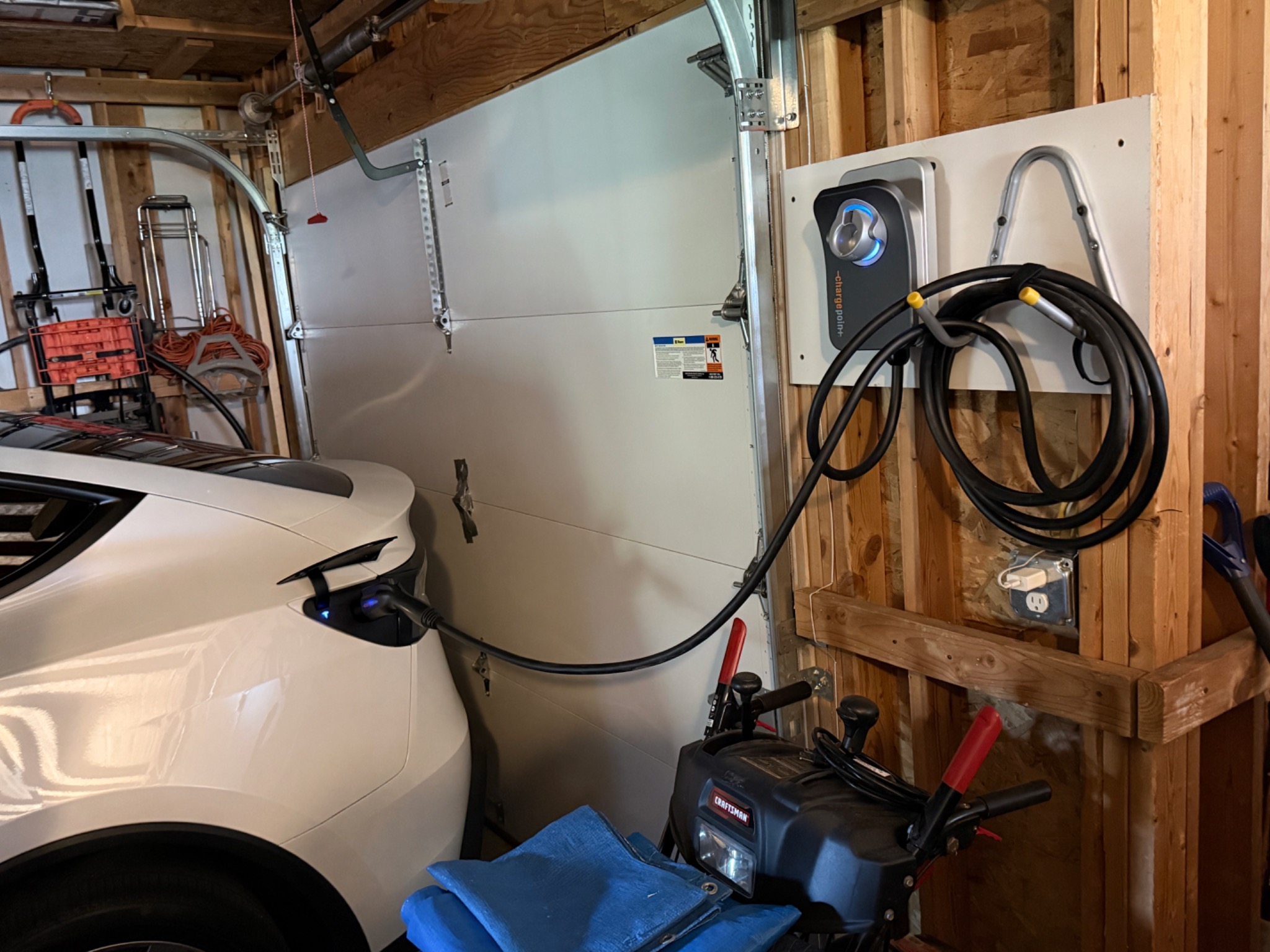
Charging at home lets you replace a stop at the gas station with a routine: park, plug in, and let the car charge while you are home. For a household comparing an electric vehicle with a gasoline vehicle, the useful question is the cost of driving the same number of miles—not the price of a full tank versus a full battery.
Your result depends on your vehicle’s efficiency, electricity plan, gasoline price, and how often you use public charging. Here is a transparent example you can adapt to your own commute.
Xcel’s Colorado off-peak rate: start with the right numbers
Xcel’s Colorado residential Time of Use schedule lists weekday on-peak hours as 5–9 p.m. All other hours, weekends, and designated holidays are off-peak. Scheduling home charging after 9 p.m. keeps it within that off-peak window.
| Season | Off-peak | On-peak |
|---|---|---|
| Summer · June–September | $0.07884/kWh | $0.21277/kWh |
| Winter · October–May | $0.06792/kWh | $0.18331/kWh |
These are base energy rates, not your complete electricity cost. Xcel also lists a $7.10 monthly Service & Facility charge, plus bill riders, fees, and taxes. Check your account’s actual plan and current bill before estimating savings. A flat-rate account does not receive a lower energy rate simply by charging at night. See Xcel’s Colorado rate table and schedule.
Home charging vs. gasoline: the same 1,000 miles
Our worked example assumes 1,000 miles per month, a gasoline vehicle that gets 30 mpg, and gasoline at $3.50/gallon. The gas price is an illustrative assumption, not a claim about today’s local pump price.
For the EV, we assume 30 kWh of battery energy per 100 miles and 90% charging efficiency. That means buying about 333 kWh from the wall to drive 1,000 miles. Charging losses are included once, not ignored or counted twice.
| How you drive | Monthly cost | What it includes |
|---|---|---|
| Gasoline · 30 mpg at $3.50/gallon | $116.67 | 33.33 gallons |
| EV · summer off-peak base rate | $26.28 | Base energy only; riders, fees and taxes extra |
| EV · winter off-peak base rate | $22.64 | Base energy only; riders, fees and taxes extra |
| EV · illustrative 12¢/kWh total variable cost | $40.00 | Assumed combined energy, usage-based charges and taxes; verify against your bill |
About $920 per year in driving-energy savings at 12,000 miles, using the assumptions above. This is a scenario—not an Xcel rate quote or a guaranteed saving.
The 12¢ scenario is a sensitivity example that allows for charges beyond the published base rate; we have not calculated it from your tariff or bill. At 15¢/kWh, the same EV would cost $50 per month, versus $116.67 for gasoline. Your bill’s actual usage-based cost is the number to use for a personal estimate.
How to calculate your own savings
- Gasoline cost: monthly miles ÷ actual mpg × price per gallon.
- EV cost: monthly miles × battery kWh per mile ÷ charging efficiency × electricity cost per kWh.
- Savings: gasoline cost minus EV electricity cost. Subtract any extra charging subscription or new fixed account fees.
If your efficiency figure already measures electricity drawn from the wall, do not add charging losses again. The existing fixed electric-service charge is not included in this comparison because it is ordinarily paid whether or not you charge an EV. Installation, charger purchase, vehicle price, financing, insurance, maintenance, and public charging are outside this fuel-only comparison.
What can change the result along the Front Range?
Use your actual driving pattern. Cold-weather cabin heating, highway speeds, mountain trips, towing, and larger vehicles can raise energy use. A plug-in hybrid only earns electric-driving savings for miles actually driven on electricity; keep its gasoline miles in a separate calculation. Public fast charging should also be entered at the price you actually pay.
For example, a 40-mile driving day at our assumed efficiency requires about 13.3 kWh from the wall. A 7.7 kW home charging setup would replenish that in roughly 1.7 hours under those assumptions. The vehicle’s onboard charger and the installation’s approved settings can limit actual charging power. We size your setup around both your overnight parking window and your home’s available electrical capacity.
Xcel’s up-to-$500 rebate and ChargePoint chargers
Eligible Colorado residential electric customers can receive up to $500 toward qualifying Level 2 charger purchases and/or 240-volt wiring. This is one combined rebate limit—not $500 for the charger plus another $500 for wiring. It is not an automatic ChargePoint discount.
Xcel requires acceptance into Optimize Your Charge and participation for at least 12 consecutive months after the rebate is issued. Its current page also lists potentially higher awards for income-qualified households and qualifying communities. Funding is first-come, first-served. Review Xcel’s rebate eligibility and application.
Which ChargePoint models can participate?
The program’s eligibility guide lists ChargePoint CPH25 and CPH50 home charging stations. An eligible charger can provide a path into the program even when the vehicle itself is not on the eligible-vehicle list. Confirm the exact model and enrollment requirements before purchasing; a ChargePoint logo alone is not proof that every product qualifies. Check the program’s vehicle and charger list.
A straightforward application checklist
- Confirm Xcel supplies your home’s electricity, and check your charger and project eligibility.
- Apply for Optimize Your Charge and confirm acceptance.
- Arrange qualifying installation with a licensed electrician and retain itemized installation and charger receipts.
- Apply through Xcel My Account and follow the current documentation and timing requirements.
Xcel makes the approval decision. Keep the rebate separate from your installation budget until approved. EV Accelerate At Home closed to new Colorado applications on July 14, 2026; new applicants should use the current Optimize Your Charge path described above.
We can help you identify the charger model, discuss the wiring scope, and provide installation documentation. HomeCharge Connect is operated by Day Electric; this guide does not imply that we are Xcel or a ChargePoint-authorized program partner.
Planning an installation in your community
We help homeowners in Broomfield, Westminster, Boulder, Longmont, and surrounding communities compare practical charging options. Your street address matters more than a city name when confirming electric service, permitting jurisdiction, and installation scope.
Broomfield and Westminster
Start with where you park and where the electrical panel sits. A panel in the garage can offer a direct wiring route; an exterior panel beside an attached garage may call for a weather-rated route and wall penetration. Share photos of both areas and tell us whether you need the cable to reach one parking space or two.
Boulder and nearby Boulder County communities
For a detached garage, finished walls, or a home with existing electric heating and other large loads, the route and available capacity deserve an early review. Include photos of the path between the panel and parking area. A Boulder mailing address alone does not establish whether the permit is handled by the city or county; we confirm the project jurisdiction.
Longmont
Check the electricity section of your bill first. Longmont Power & Communications is the city’s electric utility, so an Xcel gas account does not establish eligibility for Xcel’s electric charging rebate. Use your actual electric provider’s rates in the comparison above. Find Longmont’s utility information.
North Denver and surrounding Front Range communities
Send your address or ZIP code with the request so we can confirm service coverage and the appropriate installer. For townhomes or shared parking, let us know who owns the parking space and electric meter, and whether property-owner or association approval is needed. Shared electrical systems need an individual plan.
How installation cost fits into the savings
Qualifying HomeCharge Connect standard installations start at $1,895, including permits and standard installation materials; you purchase the charger separately. A load calculation is performed during the in-person consultation. The qualifying exterior-panel package is $2,195. Your written proposal confirms routing, scope, applicable taxes, and any additional work.
Using the illustrative $920 annual fuel saving, a $1,895 installation alone represents about 2.1 years of those savings. If a full $500 rebate is approved and applied to that installation, the remaining $1,395 represents about 1.5 years. Add the separate charger cost and any additional project costs before estimating a total payback. This is a charging-project comparison, not the payback period for purchasing an EV.
Complex installations are welcome. Detached garages, long wiring routes, and electrical upgrades receive a comprehensive quote with an explanation of the proposed work and available options. Day Electric performs your installation, with a written scope and clear pricing before work begins. See package details and inclusions.
Find out what home charging looks like for you.
Tell us your city, vehicle, typical daily mileage, and where you park. Photos of your closed electrical panel and proposed charger location help us start the conversation. Keep panel covers in place.
Request your installationPrefer to talk first? Book a free phone consultation (opens in a new tab).